Garbage Disposal Repair
Mounting, outlets and dishwasher tie ins.
About this serviceGreater Houston
A modern kitchen has more plumbing connections under one cabinet than the rest of the house has in total: a disposal, a dishwasher, a filter, a hot tap, an ice maker line and the sink itself. Each one is a small connection, and in a Dayton kitchen almost every slow leak we find began at one of them rather than in the pipe.
24/7 dispatch · Dayton · Liberty County
These two share a drain, and most kitchen drainage problems are really about how they were connected.
A disposal is plumbed into the trap arm, and it has rules. The unit has to be properly mounted and sealed to the sink, its outlet has to reach the trap with correct fall, and the drain has to be sized for it. A sagging or poorly supported connection is where leaks start.
The dishwasher drain needs an air gap or a high loop. Without one, dirty water from the sink drain can siphon back into the dishwasher. A high loop secured up under the counter is the minimum, and an air gap fitting is the more positive solution.
Punch the plug out when fitting a disposal. New disposals ship with the dishwasher inlet blanked off, and leaving that plug in place is the single most common cause of a new dishwasher that will not drain.
Do not put the dishwasher drain into a blocked line and hope. If the sink drains slowly, the dishwasher shares that problem, and running it repeatedly pushes water back into the cabinet.
Check the mounting, not just the pipe. A disposal that vibrates loose, or a sink flange that was never sealed, produces a leak that looks like a drain fault and is not.
Reset before you condemn a disposal. A unit that hums or does nothing is often jammed or tripped rather than failed, and the reset button underneath plus clearing the obstruction from the top brings most of them back. Doing that before buying a replacement is worth the two minutes.
These are the connections most likely to fail quietly, because they are small, hidden and often fitted by somebody in a hurry.
The ice maker line is the classic slow leak. A small plastic line behind a refrigerator, sometimes joined with a saddle valve, weeping into the floor for months. Saddle valves are a known failure item and should be replaced with a proper stop.
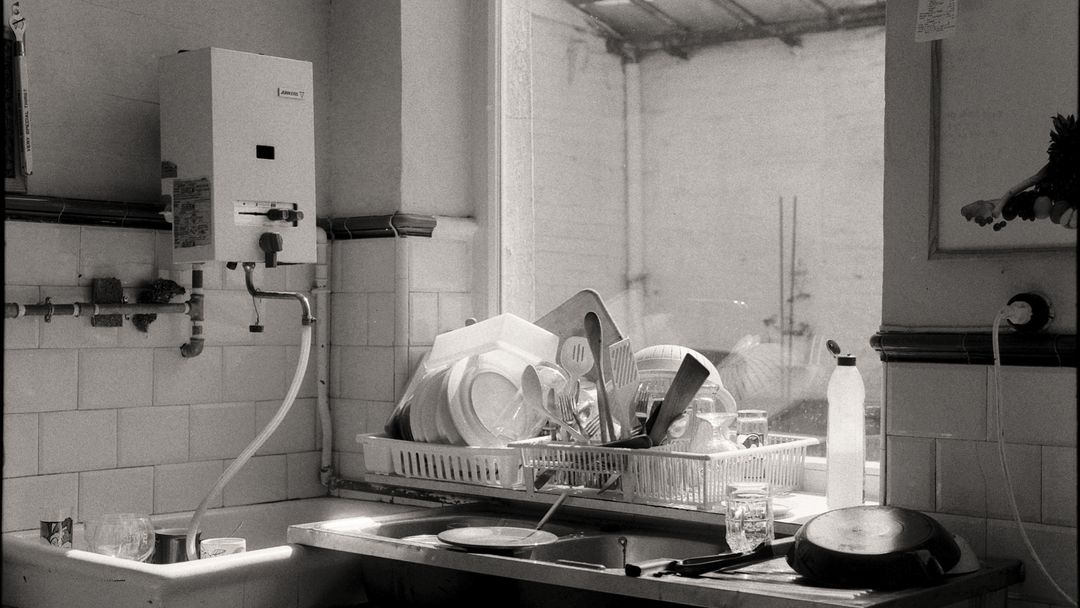
Under sink filters need somewhere to fail safely. A cartridge housing is a pressurised plastic vessel in a cabinet full of things you care about, and cartridges left in for years are both a taste problem and a leak risk.
Instant hot taps have a tank and a vent. The small tank under the sink needs its vent kept clear and its own supply connection, and when one starts spitting or dripping it is usually the tank rather than the tap.
Reverse osmosis systems need a drain connection done properly. The waste line has to be connected with an air gap arrangement, not simply pushed into the trap, and a poor connection is a cross connection.
Check under the sink twice a year. Two minutes with a torch, looking for staining, swollen cabinet base or a damp corner, catches almost all of this while it is still a fitting rather than a floor.
Every one of these needs its own shutoff. A filter, a hot tap, an ice maker line and the dishwasher should each be isolatable without closing the whole kitchen down, and on cheaper installations they frequently are not. Adding stops during any other work is inexpensive.
The damage is usually in the cabinet before it is anywhere else, and the cause is usually the sink rather than the plumbing.
An unsealed sink rim leaks every time it is used. Water runs under the rim and down the outside of the cabinet, which looks exactly like a drain leak from below. Resealing is cheap and frequently the whole answer.
Tail pieces and slip joints need to be aligned, not forced. Most under sink leaks we fix are compression and slip joints that were assembled at an angle. They weep slowly, dry out between uses and get blamed on the appliance.
A swollen cabinet base means it has been going on a while. Particle board that has lifted or turned dark is a timeline, not a symptom. Worth knowing before deciding whether the cabinet can be saved.
Faucet bodies leak underneath before they drip on top. A tap with play in the base, or damp around the mounting nuts, is failing at the connection and it will be found as a cabinet problem first.
Do not store cleaning supplies over the connections. Everything in that cabinet hides the early signs, and half of it is heavy enough to knock a supply line loose.
Line the cabinet if it has already been wet once. A tray or a sheet under the connections will not stop a leak, and it will show you the next one early and keep it off the cabinet base. On a cabinet that has already swollen, it is worth doing at the same time as the repair.
The phone is answered around the clock, holidays included. Tell us whether the water appears when the sink runs, when the dishwasher runs, or all the time, and whether the cabinet base is damp or swollen. That timing usually identifies which of the six connections is at fault.
Dayton and this part of Liberty County are on our daily route, with overnight dispatch. We check the sink seal and the appliance connections before assuming the drain, and we replace saddle valves on ice maker lines rather than re-tightening them.
FAQ
The blanking plug in the disposal's dishwasher inlet, which ships in place and has to be punched out. It is the most common cause by a wide margin on a newly fitted machine.
It is the drain hose secured up under the counter before it drops to the drain, and yes, it or an air gap fitting is needed. Without it, dirty sink water can siphon back into the dishwasher.
At the timing. Water when the sink runs suggests the sink seal or a slip joint; water when the dishwasher runs suggests its connection; water all the time suggests a supply line or a filter housing.
It is the small clamp on valve often used for ice maker lines. They are a known slow leak item, and replacing one with a proper shutoff is inexpensive and permanent.
Often it is the sink rim rather than the plumbing. Water running under an unsealed rim goes down the outside of the cabinet and looks identical to a drain leak from below.
On the manufacturer's interval, and sooner if the taste changes. An old cartridge is a taste problem and the housing is a pressurised plastic vessel in a cabinet, so neglect is a leak risk as well.
Usually it is the small tank under the sink or a blocked vent rather than the tap itself. They are a system, and diagnosing the tank first saves replacing a tap that was fine.
No, it needs a proper air gap arrangement. Pushing the waste line straight into the trap creates a cross connection, and it is one of the more common faults on a self installed system.
Nearby
Services
Mounting, outlets and dishwasher tie ins.
About this serviceFilters, RO systems and their drain connections.
About this serviceTaps, sink seals and mounting nuts.
About this serviceWorking out which connection is weeping.
About this serviceKitchen branches and trap arms.
About this serviceOvernight dispatch when a kitchen line lets go.
About this serviceTalk to someone now
Tell us when it appears: sink running, dishwasher running, or all the time. That timing narrows it to one connection before we arrive.
Call about a kitchen leak or appliance connection