Water Softener Installation
Sizing and fitting by tested hardness.
About this serviceGreater Austin
Buda water is hard, and hard water is the reason a lot of local plumbing wears out early: scaled elements, stiff cartridges, spotted glass and a heater that rumbles years before it should. Treatment genuinely helps. The equipment only earns its money when it is sized to your actual hardness and plumbed into the right part of the house.
24/7 dispatch · Buda · Hays County
Almost every bad treatment installation starts with a guess about water quality instead of a measurement.
Get grains per gallon, not an adjective. Hardness is measured in grains per gallon, and sizing arithmetic needs that figure. A test at the tap takes minutes, and your utility's annual water quality report gives a second reference point for the supply as delivered.
Hardness is not the only thing worth testing. Iron, chloramine or chlorine, total dissolved solids and pH all change what equipment suits the house. Iron in particular fouls a standard softener resin bed, so finding it beforehand changes the specification rather than the schedule.
Size by hardness times household use. Capacity is grains removed between regenerations, so a big family in hard water needs more than a couple in the same house. Undersizing means constant regeneration and salt use; heavy oversizing means resin sitting stagnant between cycles.
Metered regeneration beats a timer. A metered head regenerates on water actually used rather than on a clock, which suits a household that travels or has guests. It is the single specification choice that most affects running cost.
Ask what the house has already been through. In a subdivision where builders offered treatment as an option, some houses have a unit that was never commissioned properly and some have a bypass left permanently open. Before specifying anything new, it is worth establishing whether the equipment already on the wall is working, dormant or plumbed out of circuit entirely, because the answer occasionally makes the whole conversation unnecessary.
Placement decides whether treated water reaches what you wanted to protect and skips what you did not.
A softener loop is a specific thing. Many Buda houses were built with a loop in the garage: a pair of stubs and a bypass so equipment can be fitted without cutting into the main. If the house does not have one, adding it properly is part of the job and not an optional extra.
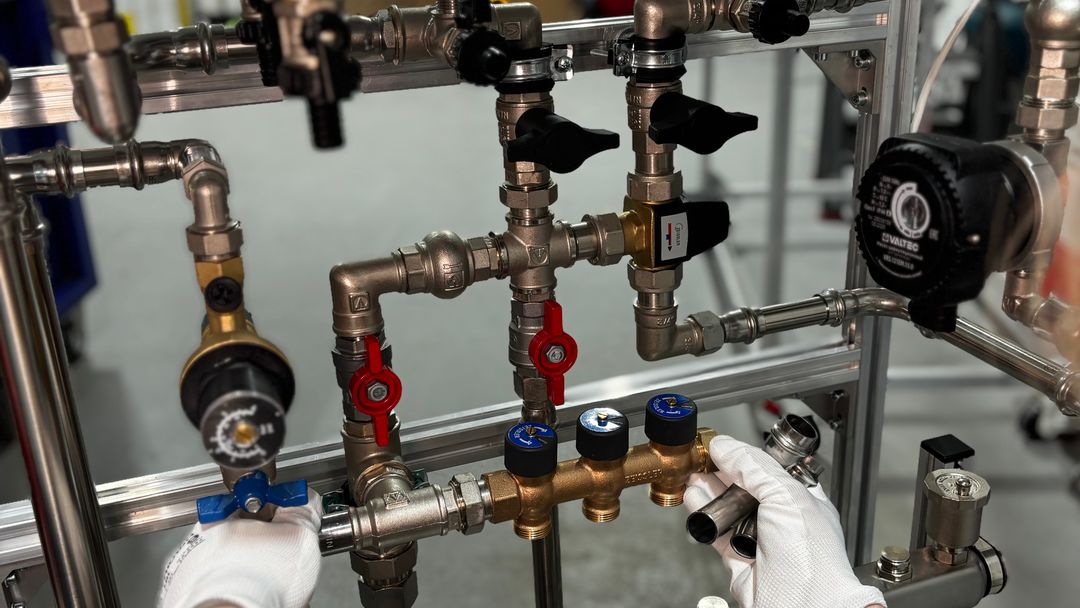
Keep outside taps and irrigation on raw water. There is no reason to soften a lawn, and doing it wastes capacity and salt while adding sodium where plants do not want it. Correct placement is downstream of the outdoor branches, which is the mistake we most often find on an installation done in a hurry.
Treat ahead of the water heater. The heater is the appliance hard water punishes hardest, so it should sit downstream of the softener. On a tankless unit that is not optional, it is what keeps descaling intervals sane.
The drain and the overflow are code items. A regeneration discharge needs an air gap to an approved drain, and the brine tank needs an overflow route. A hose pushed into a standpipe with no gap is a cross connection, not a shortcut.
Leave room to service it. Salt gets carried in by hand, filters get changed, and a unit wedged behind the car will be neglected until it stops working.
The categories are marketed as interchangeable and they do different things.
Ion exchange removes hardness. Conditioners change how it behaves. A salt based softener exchanges calcium and magnesium for sodium, so the water leaves genuinely soft. Template assisted crystallisation and similar salt free systems leave the minerals present but less inclined to form hard scale. Both have a place; only one gives you the slick water and the spot free glass.
Filtration is a separate question from softening. Carbon addresses chlorine or chloramine taste and odour, sediment cartridges catch grit, and neither softens. Bundling them is fine as long as you know which unit is doing which job.
Salt free suits a house that cannot drain or cannot carry salt. No regeneration means no discharge line and no salt to lift, which sometimes settles the decision on its own.
Treatment does not fix pressure, and it does not fix existing scale. A softener will not clear a blocked aerator or descale a heater that already has an inch of sediment in it, and a poorly chosen cartridge filter can reduce flow noticeably. Existing damage gets addressed separately.
The phone is answered around the clock, holidays included. If you are asking about treatment, it helps to know whether the garage has a loop with stubs and a bypass, and whether there is a nearby drain. If you have a hardness figure or a recent test, have it to hand.
Buda and northern Hays County are on our daily route, with overnight dispatch. We test before we specify, we place equipment so irrigation stays on raw water, and we will tell you plainly when a filter cartridge and a heater flush would serve you better than a new system.
FAQ
Hard enough that scale is the normal wear pattern on heaters and cartridges here. For your own figure, a test at the tap gives grains per gallon in minutes, and your utility's annual water quality report gives the supply side number for comparison.
A salt based softener actually removes hardness and gives you soft water. Salt free conditioners leave the minerals in but discourage scale. If you want slick water and spot free glass, that is the salt based unit; if you cannot run a drain or carry salt, the conditioner is the practical choice.
A softener loop, left by the builder so equipment can be connected without cutting into the main line. If yours was never fitted with a loop, one can be added, and that work should be quoted as part of the install.
No. Softening irrigation wastes capacity and salt and puts sodium where plants do not want it. The equipment should sit downstream of the outdoor branches so the lawn and hose bibs stay on raw water.
No, and a badly chosen filter can make flow worse. Pressure and flow are separate issues, measured at the hose bib and at the meter, and they need their own diagnosis.
A salt based unit does, with a proper air gap to an approved drain, plus an overflow route for the brine tank. Running the discharge hose straight into a standpipe with no gap creates a cross connection.
It depends on hardness and how much water the house uses, which is why a metered head is worth specifying. Metered regeneration runs on actual consumption rather than a timer, so you are not making soft water for an empty house.
Not on its own. Treatment stops new scale forming but does not remove the sediment already in the tank. That needs a flush, and on an older heater it is worth checking the anode at the same time.
Nearby
Services
Sizing and fitting by tested hardness.
About this serviceCarbon, sediment and combined systems.
About this serviceScale, sediment and anode work.
About this serviceKeeping a tankless unit off the scale cycle.
About this serviceCartridges and aerators that hard water ruined.
About this serviceOvernight dispatch in northern Hays County.
About this serviceTalk to someone now
Tell us whether the garage has a softener loop and where the nearest drain is. We test first, size to your real hardness, and keep the irrigation on raw water.
Call about softener or filtration work