Leak Detection
Finding the run behind a stain.
About this serviceGreater Austin
Manor has grown fast enough that most of the houses here were plumbed in the PEX era, many of them on a manifold with a separate line running to every fixture. It is a good system and it behaves nothing like the copper it replaced. Knowing which parts of it can be isolated, and which fittings are the ones that fail, saves a lot of drywall.
24/7 dispatch · Manor · Travis County
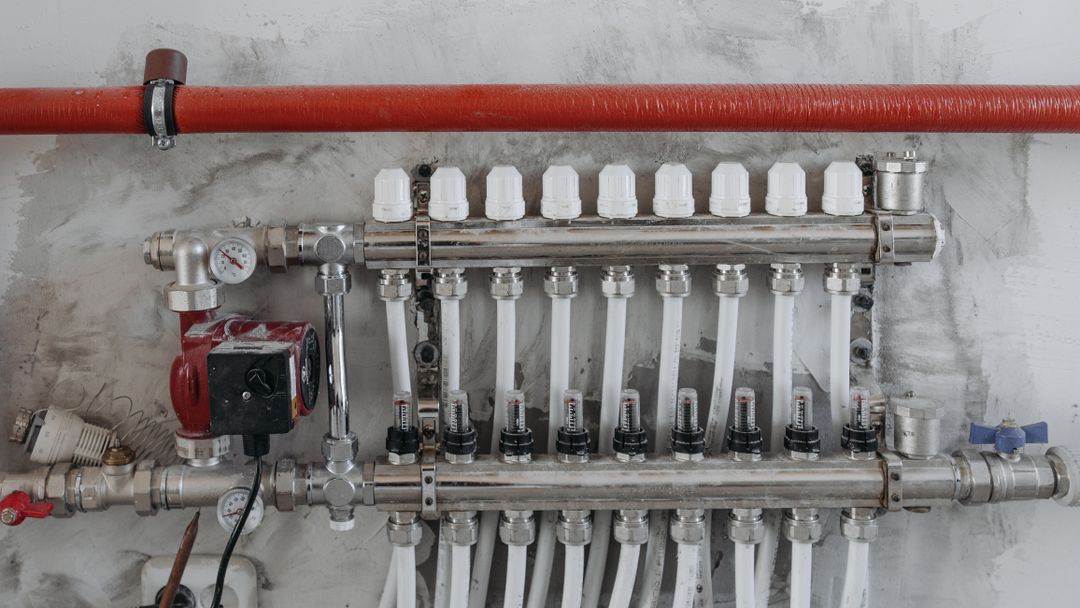
If your utility closet or garage wall has a panel with a dozen labelled valves on it, your house is plumbed home run rather than trunk and branch.
Every fixture has its own line back to the manifold. Nothing tees off in the wall on the way. That means a single continuous pipe from the manifold to the shower, with no buried joints to fail between the two.
You can isolate one fixture without touching the rest of the house. That is the practical win. A weeping toilet supply becomes a turn of one valve at the panel instead of shutting down the whole property, and the dishwasher can be taken out of service while everyone still showers.
Label the panel now, not during the leak. Factory tags fade and get painted over. Twenty minutes with a marker and a helper turning taps on gives you a panel that anyone in the house can use in the dark, which is exactly when it matters.
Smaller pipe, faster hot water, less stored volume. Individual runs are often half inch or three eighths, so there is less cold water to clear before hot arrives at a bathroom. It also means a fixture can be starved if several taps on the same manifold side run at once, which is a design characteristic rather than a fault.
PEX tubing itself rarely fails in service. Almost everything we are called to is at a connection or a point of physical damage.
Three fitting families, and they are not interchangeable. Expansion fittings use the pipe's own memory to grip a rigid insert, crimp and clamp fittings squeeze a ring over a barbed insert, and push fit connectors seal with an internal o-ring and grab ring. A repair needs the right tool for the family that is already in the wall, and mixing systems by eye is how weeping joints happen.
Brass insert fittings in aggressive water are a known weak point. Where fittings sit in a wall, a failure shows as a slow stain rather than a burst, and identifying the fitting type present decides whether a swap or a longer repair is sensible.
Kinks, staples and nail plates. A kink from the rough in stays a restriction for the life of the house, and a staple driven too tight slowly abrades the pipe. Both show up years later as a pinhole in an odd place with no obvious cause.
Sunlight is the enemy of stored PEX. Tubing left out on a jobsite loses chlorine resistance to UV exposure, and in a fast building subdivision that history is invisible once the drywall is up. It is one reason failures cluster by builder and by year rather than at random.
What actually happens when a home run system needs attention.
Most repairs replace a run, not a section. Because the line is continuous, pulling a fresh length from the manifold to the fixture is often quicker and better than splicing mid wall. Where access forces a coupling, it should be a proper fitting in the correct family and left accessible where possible.
Rodents in the attic chew PEX. It is soft, and a gnawed line in an attic run is a real and regular cause of ceiling damage in newer subdivisions. If pest control has been out, it is worth looking at the water lines while someone is up there.
PEX tolerates a freeze better than copper, and it is not immune. The tubing can expand and often survives, but the fittings and the valves at each end will not stretch with it. Attic and exterior wall runs still need insulation, and a hard freeze still means dripping fixtures on the coldest lines.
Know where the whole house shutoff is as well as the panel. The manifold isolates fixtures downstream of itself. A problem in the line feeding the manifold, or at the water heater, needs the main valve or the meter, so both should be findable in under a minute.
Keep the offcuts and the paperwork. A short length of leftover tubing and a note of the fitting system used at rough in turns a future repair into a twenty minute visit instead of a diagnostic exercise. In a subdivision where every street was plumbed by a different crew in a different year, that one scrap in the garage is genuinely useful information about your own house.
The phone is answered around the clock, holidays included. If you can, tell us whether the house has a manifold panel and whether the leak stops when you close one valve on it. That one answer usually tells us which run is involved before we arrive.
Manor and eastern Travis County are on our daily route, with overnight dispatch. We carry tooling for the expansion, crimp and clamp systems so a repair is made in the family the house already uses, and we will show you the panel and label it while we are there.
FAQ
A manifold. Each valve feeds one fixture on its own continuous line, so you can isolate a single toilet or sink without shutting off the house. Labelling it clearly is the most useful thing you can do with it.
No, and it has real advantages here: no buried joints between manifold and fixture, better freeze tolerance, and quicker hot water on short runs. Its weak points are fittings and physical damage rather than the tubing itself.
Only with the right tool for the fitting family already installed, whether that is expansion, crimp, clamp or push fit. Mixing systems because a fitting looks similar is a common cause of joints that weep months later.
Close manifold valves one at a time and watch whether the drip stops, which identifies the run. Attic runs and fittings are the usual culprits, and in newer subdivisions rodent damage is high on the list.
Yes. The tube can stretch but the fittings and valves at each end cannot, and attic or exterior wall runs are still exposed. Insulate those runs and drip the coldest fixtures on a hard freeze night.
Usually not. Home run systems use smaller individual lines, so simultaneous demand on the same side of the manifold is felt more than on old trunk plumbing. If it is severe or new, the manifold feed and pressure at the house are worth measuring.
It can be done with a correct fitting, but replacing the whole run from the manifold is often faster and leaves no buried joint. Where a coupling is unavoidable we try to leave it accessible.
Neither as a blanket rule. What matters is using a fitting rated for the system and the water it sees. We identify what is installed first, then recommend swapping only where the existing type has a known problem.
Nearby
Services
Finding the run behind a stain.
About this servicePEX splits, fittings and attic runs.
About this serviceWhen a run or a system needs replacing.
About this servicePressure at the house, ahead of the manifold.
About this serviceAttic and exterior wall runs after a freeze.
About this serviceOvernight dispatch in eastern Travis County.
About this serviceTalk to someone now
Tell us whether closing one manifold valve stops it. That narrows the search to a single run before we arrive, and it is usually the difference between one access hole and several.
Call about a PEX or manifold problem