Sewer Line Repair
Laterals and taps on rebuild lots.
About this serviceGreater Houston
Bellaire rebuilds itself lot by lot. A house comes down, a larger one goes up, and two things almost always stay: the tap at the sewer main and the water service at the meter. Those inherited connections decide more about the new house's plumbing than any fixture choice, and they are worth testing before the slab is poured rather than after.
24/7 dispatch · Bellaire · Harris County
On a teardown lot, demolition removes the building. It does not remove the infrastructure the building was attached to.
The tap at the main is a permanent asset. The connection where your lateral meets the public sewer was made once, decades ago, and reusing it avoids cutting the street. Whether that is wise depends entirely on its condition, not its age alone.
The meter and the service line to it are the utility's side. Responsibility typically changes hands at the meter, and everything from there into the property is yours. On a rebuild that private run is frequently the original galvanised or undersized line, sized for a much smaller house.
The old lateral runs somewhere you have not mapped. It leaves the old slab position, not the new one. A larger footprint often lands the new house on top of the old route, which is a problem best discovered before concrete.
Abandonment is a task, not an omission. Any section taken out of service should be cut and capped so it cannot carry water, collect groundwater or collapse into a void under the new driveway. Simply leaving it is how a sinkhole appears in a two year old front yard.
Demolition is when lines get damaged, not just abandoned. Machinery breaking up an old slab works at exactly the depth of the under slab drainage, and a lateral that was sound in the survey can be crushed on the day the house comes down. Knowing where it runs before demolition, and rechecking it afterwards, is how that gets caught while the ground is still open rather than after the new plumbing is tied in.
Everything about reuse is a condition question, and the answers are cheap to get while the lot is open.
Camera and locate the lateral first. A survey gives you material, depth, fall, joint condition and the actual route across the lot. That single exercise decides whether the old line is an asset you are keeping or a liability you are building over.
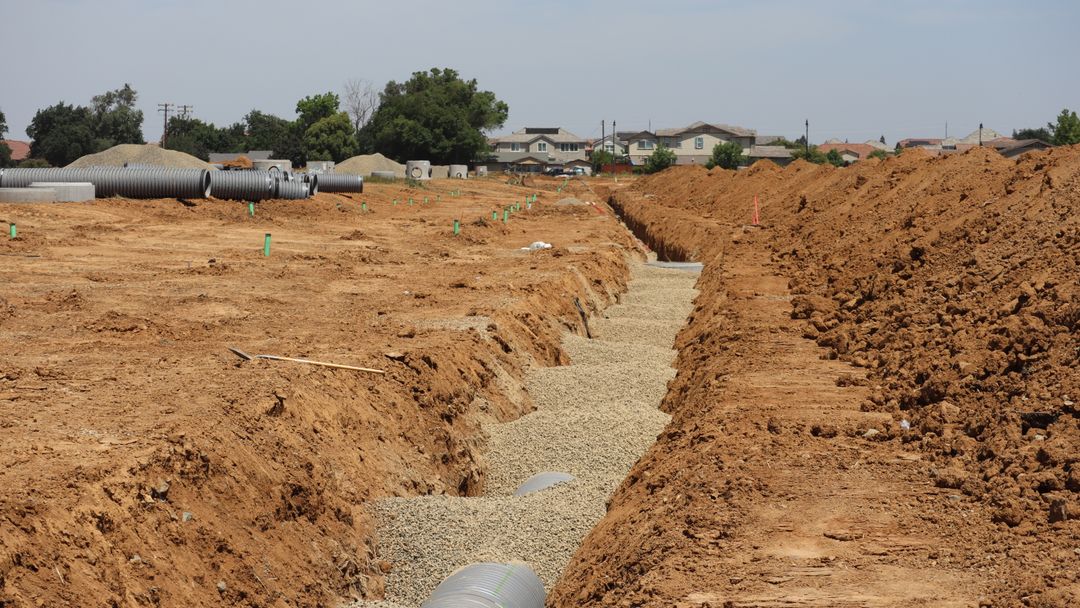
Material tells you the likely remaining life. Cast iron and clay tile laterals of a certain era are near or past the end of their service life, and reusing the last twenty feet to the tap while replacing the rest is a common and sensible compromise.
A raised slab changes the fall you have to work with. New builds here often sit higher than the house they replaced for flood reasons. Raising the fixtures while the tap stays where it is gives you more fall, which is usually good, but it also means the plan needs checking rather than assuming the old grade still applies.
Hydrostatic testing has a moment. With the new under slab drainage in place and before the pour, a test proves the system holds. After the pour, the same information costs a great deal more to obtain.
Keep the survey and the as built. A photograph of the trench with a tape in it, and a marked plan of where the lateral crosses the lot, is worth real money at the next repair or the next sale.
The new house usually has more bathrooms, more outdoor demand and appliances the old service never anticipated.
Count the demand before choosing a pipe size. Fixture counts, a pool autofill, irrigation zones and a tankless heater all add up. A three quarter inch private service that was adequate for a 1950s bungalow is often the reason a new five bathroom house feels weak at the third tap.
Measure static pressure and flow at the meter. Pressure alone is not the answer. Both numbers, taken before design, tell you whether the constraint is the street, the service line size or the house's own layout.
Gas load deserves the same arithmetic. A larger house with a tankless unit, a range and a pool heater can exceed what the existing gas service and pipe sizing were built to deliver. It is a calculation, not a guess, and it is far cheaper before the walls close.
Consider separating irrigation. A dedicated irrigation connection with its own backflow protection keeps the sprinkler system from competing with the house, and simplifies the compliance paperwork that comes with it.
Plan for a future connection while the ground is open. A sleeve under the new driveway, a stubbed line to where a pool or an outdoor kitchen might go, and a labelled isolation valve for each cost very little during construction. Every one of them is an excavation you have already paid for and will not have to pay for twice.
The phone is answered around the clock, holidays included. On a rebuild, tell us what stage the lot is at, whether the old lateral has been located, and what the fixture count of the new house will be. On an existing house, tell us what changed most recently on the property.
Bellaire and the inner loop side of Harris County are on our daily route, with overnight dispatch. We survey and test rather than assume, we give you the route of the old lateral in writing, and we say clearly when reusing an inherited connection is a false economy.
FAQ
Often yes, and it avoids cutting the street. It depends on the condition of the tap and the last section of lateral, which a camera survey establishes. Age alone does not rule it out, but it does mean checking.
They should be cut and properly capped so they cannot carry water, fill with groundwater or collapse later. Abandoned lines left open under a new driveway are a common cause of settlement a few years on.
It usually helps, because you gain fall to a tap that has not moved. It does need checking rather than assuming, particularly where the new footprint crosses the old lateral route at a different depth.
It depends on fixture count plus irrigation, pool autofill and any tankless heater. Many larger rebuilds need a bigger private service, and that is the cheapest thing in the world to upsize while the lot is still open.
Before the slab is poured, ideally before the plan is finalised. It tells you route, depth, fall and material at a point when acting on the answer is still inexpensive.
It is the right moment for one. Proving the system holds before the pour is straightforward, and finding the same defect afterwards means breaking concrete to reach it.
It can be. A live line under a new slab with no access is a future repair with no good options, so the usual answer is to reroute it outside the footprint while the ground is open.
On a larger lot it is worth it. A separate connection with its own backflow protection stops the sprinklers competing with the house and keeps the required testing paperwork tidy.
Services
Laterals and taps on rebuild lots.
About this serviceRoute, depth, fall and material.
About this serviceHydrostatic testing before the pour.
About this serviceUpsizing the private service.
About this serviceLoad and sizing for a larger house.
About this serviceOvernight dispatch inside the loop.
About this serviceTalk to someone now
Tell us what stage the lot is at and whether the old lateral has been located. A survey now costs a fraction of finding the same information through a finished slab.
Call about a rebuild or a buried connection