Main Water Line Repair
Supply lines below the water table.
About this serviceGulf Coast
In La Marque the groundwater sits close to the surface, and that single fact changes the price and the method of every repair that involves a shovel. A pit that would stay dry in Plano fills here while you are still standing in it. Knowing that in advance is the difference between a repair that holds and one that settles out of line in two summers.
24/7 dispatch · La Marque · Galveston County
Most buried repair work in La Marque runs into water long before it runs into pipe, and that governs everything that follows.
The hole fills from the sides, not from the top. Once an excavation goes below the water table, groundwater seeps in through the walls continuously. It is not rain and it does not stop, so the pit has to be kept dewatered with a pump running for as long as the repair takes.
Wet sand does not stand up. Saturated soil loses the friction that holds a trench wall together, so a deeper excavation needs shoring or benching rather than vertical sides. This is a safety requirement, and it is also why a deep repair takes a bigger hole and a longer day than the same repair a hundred miles inland.
Working blind costs more than working slowly. A pit with six inches of water in the bottom hides the very joint you came to inspect. Pumping down, then cleaning the pipe by hand, then looking, is slower than it sounds but it is the only way to be sure you are repairing the actual defect and not the first thing you felt with your boot.
Ask what the quote includes. Dewatering, shoring, spoil handling and compacted backfill are real line items here. A number that assumes a dry hole is not a number for this ZIP code, and the gap tends to appear halfway through the job.
The water does not just slow the dig. It attacks the parts of the repair nobody sees again.
Bedding and backfill decide whether the repair stays in line. A drain line needs continuous support at a consistent grade. If the bedding sand migrates away in flowing groundwater, the pipe loses support in patches and develops a belly that holds water and catches solids. Graded stone bedding and mechanical compaction in lifts cost a little more on the day and prevent exactly that.
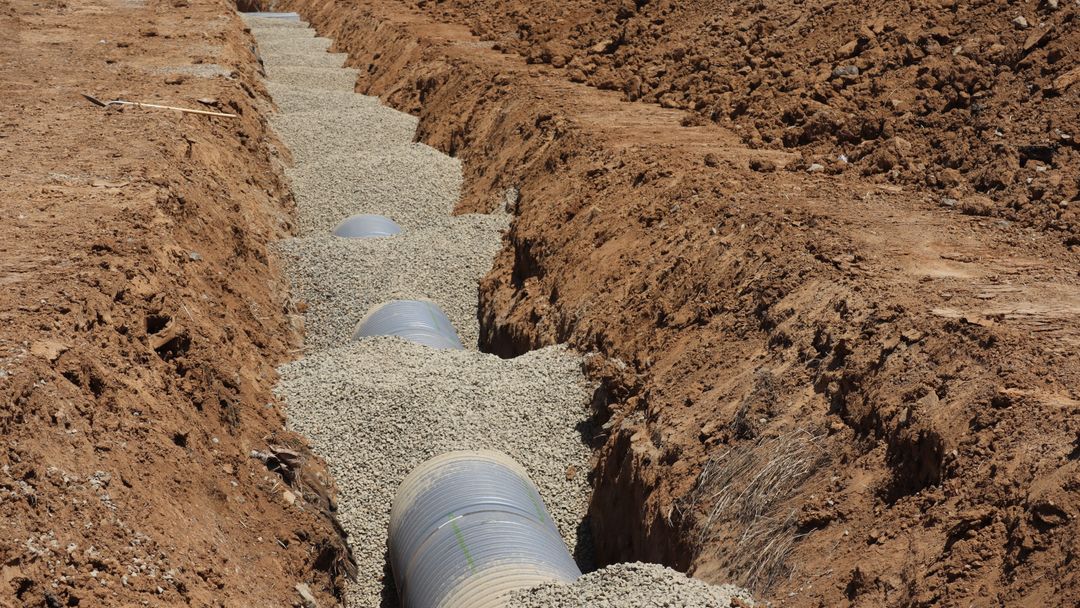
Empty pipe in wet ground can float. A newly laid section that has not been backfilled properly can lift in saturated soil before it is loaded, which is one of the quieter reasons a fresh repair ends up with the wrong fall. Ballasting and backfilling promptly is part of the job, not an afterthought.
Solvent welds want clean, dry surfaces. Cement joints made on a wet pipe in a wet hole are the joints that weep later. Wiping down, working in a pumped pit and giving the joint its set time matters more here than the weather ever suggests.
Test before the hole closes. Once backfill goes in, reopening is a second excavation at close to full price. A pressure or hydrostatic test with the pipe still visible is the cheapest ten minutes of the whole job.
Corrosion runs faster in wet ground. Buried metal in permanently damp soil, especially where fill has been brought in, gives up far sooner than the same pipe inland. Where an old galvanised or steel run is opened up and found thinning, replacing the length rather than patching the hole is usually the cheaper decision over any sensible time horizon, because the next pinhole is already forming a few feet away.
Because excavation is expensive here, the method conversation is worth having properly before anyone breaks ground.
Lining and pipe bursting avoid most of the trench. A lateral that is still on line and still has fall can often be rehabilitated from two small access pits rather than an open cut down the length of the yard. Where the existing line has collapsed or lost grade, that changes, which is why a camera survey comes before the quote.
Rerouting above ground beats fighting the water table. For a supply line under a slab or a driveway, running a new line through the attic or around the outside of the house is frequently cheaper, faster and easier to service later than tunnelling to the old route.
A cleanout standing full of clear water tells you something. Clear groundwater in a cleanout or a sewer that runs harder after a wet week points to infiltration through cracked pipe or bad joints rather than a blockage. Snaking that line clears nothing, because nothing is blocking it.
Spot repair is legitimate when the rest of the pipe earns it. One offset joint in an otherwise sound line does not justify replacing the run. The camera decides, and the honest answer here is sometimes the small one.
The phone is answered around the clock, holidays included. Tell us whether you have standing water, where the wet ground is in relation to the house and the meter, and whether anything has been dug on the property recently, because that shapes what we bring.
La Marque and the mainland side of Galveston County are on our daily route, with overnight dispatch. We camera and locate before we quote a dig, we say plainly when a trenchless or rerouted repair is the better value, and we do not price a wet hole as though it were a dry one.
FAQ
Because the hole has to be kept pumped dry and often shored while the work happens. Dewatering, shoring and properly compacted backfill are real costs here, and a quote that assumed dry ground would have to be revised on the day anyway.
Clear water points to the supply side or to groundwater rather than sewage. We check the meter for movement with the house isolated, which separates a pressurised leak from ordinary high groundwater after rain.
Often yes. If the existing lateral still has line and fall, it can be lined or burst from two small pits instead of an open trench. A camera survey tells us whether the pipe is a candidate before you commit to a method.
No. In saturated soil, sand bedding can wash out and leave the pipe unsupported in patches, which creates a belly that holds water. Graded stone and compaction in lifts is what keeps the grade you paid for.
That pattern usually means groundwater is getting into the line through cracks or open joints and filling it, so there is no spare capacity for the house. The fix is sealing the pipe, not clearing it.
Yes, and it should be. With the pipe still exposed we can pressure test supply work or hydrostatically test drainage. Reopening a closed excavation here costs nearly what the first one did.
It is common and often the better option locally, because it avoids working below the water table under a slab. It also leaves the new line accessible if anything ever needs attention again.
For the duration of the repair, and sometimes a little beyond while the backfill is compacted. It is noisy and it discharges water, so we agree where that water goes before we start.
Nearby
Services
Supply lines below the water table.
About this serviceOpen cut and spot repairs in wet ground.
About this serviceLining and bursting from small pits.
About this serviceDeciding the method before the dig.
About this serviceGoing around the water table instead of through it.
About this serviceOvernight dispatch on the Galveston County mainland.
About this serviceTalk to someone now
Tell us where the water is showing and what has been excavated nearby. We survey the line first, then quote the method that suits the ground rather than the one that suits the truck.
Call about a buried line or a wet yard